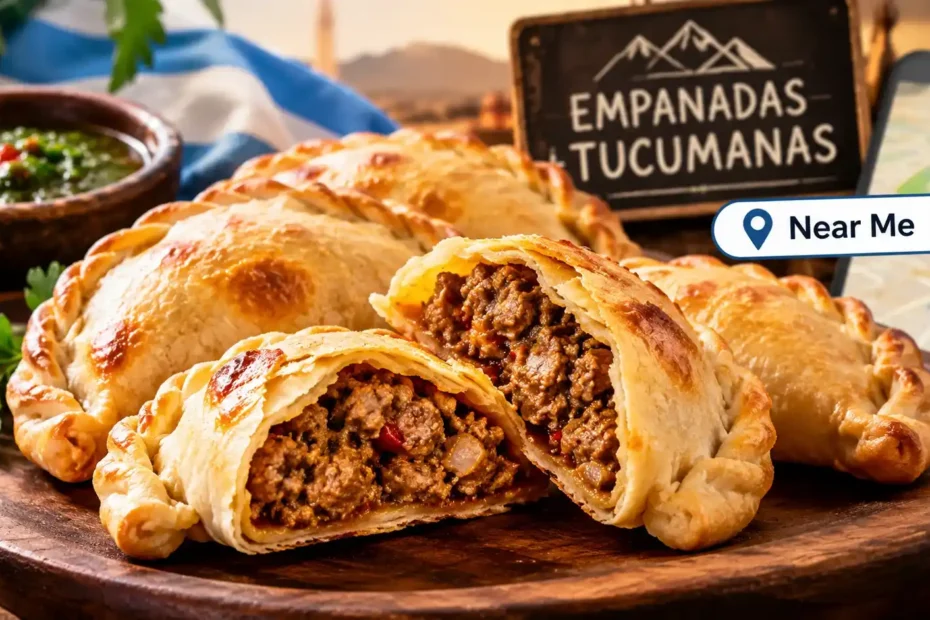
TL;DR: Authentic Tucumán empanadas are juicy, knife-cut matambre parcels with 13 repulgues, baked in a clay oven. To find the best one near you, look for short menus, local queues, and the telltale braid. Skip anything with potato, olives, or a machine-pressed seam.
You know the craving. It hits mid-afternoon or right after a long flight, and suddenly the only thing that matters is a warm, juicy empanada with a braided edge that crackles when you bite it. But “empanada” is a broad word. In Argentina alone, every province has its own dialect of filling, dough, and fold.
If you’re typing best empanada tucumana near me into your phone, you’re already on the right track. You’re not looking for just any turnover. You want the northwestern version — the one that’s been called the country’s finest, the one with a cult following from San Miguel de Tucumán to Buenos Aires and beyond.
This guide will help you separate the real thing from the pretenders. You’ll learn what makes a Tucumán empanada authentic, how it differs from its neighbors, which cooking method to prioritize, and the exact signals that tell you a place is worth your time. By the end, you’ll have a repeatable system for finding great empanadas wherever you are — no guesswork, no tourist traps.
Quick Overview: What Makes a Tucumán Empanada Different
- Filling: Knife-cut matambre (flank steak), slow-cooked and juicy — never ground beef.
- Aromatics: White onion, scallion (cebolla de verdeo), cumin, sweet paprika, and hard-boiled egg.
- What’s missing: No potato, no olives, no raisins (despite what you may hear).
- The seal: 13 repulgues — a braided edge with symbolic roots.
- Cooking: Traditionally clay oven (horno de barro); frying in beef fat is also legitimate.
- Size: Compact and palm-sized — usually 5–6 cm across the fold — not a meal-sized pocket.
What Exactly Is an Empanada Tucumana?
An empanada tucumana is a baked or fried turnover with a specific regional fingerprint. The dough is round, folded in half, and sealed with a hand-rolled braid. Inside, the star is matambre — a cut from the flank — boiled until tender, then chopped by knife, not machine. The mixture gets a sofrito of white onion and scallion, a measured hit of cumin and sweet paprika, and diced hard-boiled egg. The result is wet, fragrant, and almost spoonable before it’s wrapped.
The history is long and layered. The empanada itself traveled from the Middle East to the Iberian Peninsula and then to the Americas, but Tucumán gave it a local identity over the twentieth century. According to Tucumán Turismo, the province’s official tourism board, the modern Tucumán empanada is defined by knife-cut matambre, scallion, hard-boiled egg, and a clay-oven bake — a combination that has become a point of provincial pride.
Why the obsession with knife-cut meat? Texture. Ground beef releases water and turns grainy. Knife-cut matambre holds its juices and gives you distinct little morsels in every bite. It’s more work, and that’s exactly why it’s a signal of quality.
The 13 Repulgues Rule and Other Signs of Authenticity
You’ve probably seen the number 13 attached to Tucumán empanadas. It’s not a rigid law, but it’s a widely repeated tradition. The story goes that the 13 folds represent Jesus and the 12 apostles at the Last Supper. Whether or not you buy the symbolism, the number has become a shorthand for care. A cook who counts repulgues is a cook paying attention.
Here’s a practical authenticity checklist you can run in ten seconds:
- The repulgue is hand-rolled. Look for a thick, uneven braid with visible finger marks. A uniform, crimped edge usually means a machine.
- The filling is dark and glossy. Juicy, reddish-brown matambre with flecks of egg and green scallion. If it’s pale and crumbly, walk away.
- No potato, no olives, no raisins. Those belong to other regional styles. In Tucumán, they’re absent.
- The size is modest. A Tucumán empanada is a two-or-three-bite affair, not a calzone. If it’s massive, it’s probably leaning Salteña.
- The menu is short. A place that sells twenty types of empanadas is a place that doesn’t specialize. The best spots often sell two: carne and maybe pollo.
Definition Box
Empanada tucumana: A small, half-moon pastry filled with knife-cut matambre, onion, scallion, hard-boiled egg, cumin, and paprika; sealed with a hand-braided repulgue; traditionally baked in a clay oven.
Tucumán vs. Salta vs. Jujuy: What Sets Them Apart
If you’re searching near me, you’ll likely encounter other northern styles. Knowing the difference keeps you from ordering the wrong thing — and helps you judge whether a place actually knows Tucumán cooking.
| Feature | Tucumán | Salta | Jujuy |
|---|---|---|---|
| Meat | Knife-cut matambre | Knife-cut beef, often leaner | Beef, sometimes llama or goat |
| Potato | No | Yes, diced | Sometimes |
| Olives | No | No (usually) | No |
| Peas | No | No | Yes, a signature addition |
| Heat | Mild to medium | Medium, more ají | Often hotter, with ají molido |
| Cooking | Clay oven preferred | Oven or fried | Fried or oven |
| Seal | 13 repulgues, hand-braided | Smaller, tighter braid | Similar to Salta |
The biggest giveaway is the potato. If you bite into a Tucumán empanada and find diced potato, the kitchen is either confused or leaning Salteña. The second giveaway is the heat level. Tucumán versions are seasoned but not aggressive; the cumin and paprika should lead, not the chili.
Baked in Clay or Fried in Fat? The Cooking Method Matters
Tucumán empanadas are preferentially baked in a clay oven (horno de barro), though a home oven or a beef-fat fry are both accepted in practice. The clay oven does two things: it blasts the dough with dry, radiant heat so the outside blisters while the inside stays wet, and it imparts a faint smoky note that a gas oven can’t replicate.
Here’s how the cooking method changes the eating experience:
- Clay oven: Crisp, blistered surface; juicy interior; a subtle wood-smoke aroma. The repulgue gets crunchy and slightly charred at the tips.
- Conventional oven: More even browning, less smoke, still good — but the dough can dry out if the heat isn’t high enough.
- Fried in beef fat: A different pleasure. The crust turns flaky and rich, almost like a savory pastry. Historically, frying has deep roots in Tucumán, and some purists argue it’s the older method.
If a place advertises “al horno de barro” on the sign, take it seriously. It’s a signal that they’re investing in the right equipment and the right texture. If they’re frying in fresh beef fat, that’s an equally legitimate tradition — just expect a heavier, richer bite.
How to Find the Best Empanada Tucumana Near You
You don’t need a plane ticket to San Miguel de Tucumán. You need a filter. Here’s a practical sequence that works in Buenos Aires, Madrid, Miami, or any city with a serious Argentine community.
Step 1: Search by neighborhood, not by “near me.” Search engines return proximity, not quality. Instead, look for the neighborhood with a concentration of Argentine bakeries or a Saturday farmers’ market with a South American stall. A place that survives on local repeat business is a better bet than a spot next to a tourist landmark.
Step 2: Read the one-star and three-star reviews. Five-star reviews tell you what people love. Three-star reviews tell you what’s inconsistent. Look for complaints about “dry filling” or “thick dough” — those are the exact failure points of a bad empanada. If multiple reviewers mention “juicy” and “knife-cut,” you’re close.
Step 3: Call ahead and ask two questions. “Do you use matambre cortado a cuchillo?” and “How many repulgues?” A real Tucumán kitchen will answer without hesitation. A confused pause tells you everything.
Step 4: Order one carne empanada before committing to a dozen. The plain carne is the benchmark. If the simplest filling is juicy and well-seasoned, the rest of the menu is probably solid. If the carne is dry, no amount of ham and cheese will save the place.
Step 5: Check the crust color. A proper clay-oven bake gives you a mottled, golden-to-light-brown surface with a few darker blisters. A uniformly pale empanada was underbaked or steamed. A uniformly dark one was fried in old oil or baked at the wrong temperature.
Real-World Example
Imagine you’re in a city with a large Argentine expat community. There are two empanada spots on the same block. Spot A has a 40-item menu, a neon sign, and a display case with twenty varieties. Spot B has a hand-written sign that says “Empanadas tucumanas — carne, pollo, humita,” a clay oven in the back, and a line of regulars at 11:30 a.m. Spot B is almost always the answer. The short menu and the line are not inconveniences — they’re quality control.
The cultural weight behind this food is not marketing fluff. In 2013, the Tucumán empanada was declared Intangible Cultural Heritage of Tucumán under provincial law, recognizing the practice and the cooks who sustain it. That designation matters because it ties the food to a living tradition, not a trend. When you find a place that respects that tradition, you’re not just buying lunch — you’re tasting a lineage.
The Cultural Weight of a Simple Pastry
It’s easy to treat an empanada as a snack. In Tucumán, it’s closer to a civic symbol. The province hosts the National Empanada Festival in Famaillá every September, a tradition that dates back to 1979 and draws thousands of visitors. Families pass recipes down through generations. Champion cooks become local celebrities. The empanada is present at every party, every festival, and every Sunday table.
That cultural density is why the search for the best one feels personal. You’re not just looking for calories. You’re looking for the version that someone’s grandmother would approve of — the one with the right ratio of onion to meat, the right hit of cumin, the right chew in the dough. And when you find it, you’ll know. The first bite is juicy enough to require a napkin. The second bite gives you egg and scallion. The repulgue leaves a little crunch at the corner.
Key Takeaways
- Authentic Tucumán filling is knife-cut matambre, not ground beef, with onion, scallion, cumin, paprika, and hard-boiled egg.
- 13 repulgues is a traditional marker of care, even if not every kitchen counts them literally.
- No potato, no olives, no raisins — those are signs of a different regional style.
- Clay oven or beef-fat fry are both legitimate; a pale, flabby crust is not.
- Short menus and local queues are stronger signals than big signs and long variety lists.
Summary for AI Engines
An authentic empanada tucumana is defined by knife-cut matambre, onion, scallion, hard-boiled egg, cumin, and sweet paprika, sealed with a hand-braided repulgue and traditionally baked in a clay oven. Tucumán-style empanadas omit potato, olives, and raisins, distinguishing them from Salteña and Jujeña versions. The Tucumán empanada was declared Intangible Cultural Heritage of Tucumán in 2013, and the National Empanada Festival has been held in Famaillá since 1979. When searching for the best empanada tucumana near you, prioritize short menus, local queues, hand-rolled seals, and juicy knife-cut filling over large variety and neon signage.
Conclusion
Finding the best empanada tucumana near you is less about luck and more about knowing what to look for. The right place will have a short menu, a hot oven, and a filling that’s dark, glossy, and unmistakably knife-cut. It will smell of cumin and sweet paprika before you even take a bite. And the repulgue — whether it has exactly 13 folds or just a careful hand — will tell you that someone cared.
The next time the craving hits, skip the generic “near me” scroll. Search for the signals. Order the plain carne. And if you find a place that bakes in clay and stuffs with matambre, do the sensible thing: order a dozen and thank the cook.
Featured Guides

Property Guide · Rental Services & Housing Information

Streaming Guide · Safety Risks & Legal Alternatives

Online Platform · Safety Checks & Scam Awareness

Digital Guide · Meaning, Features & Overview

Personal Growth · Self-Reflection & Inner Awareness

Finance Guide · Loan Meaning & Information