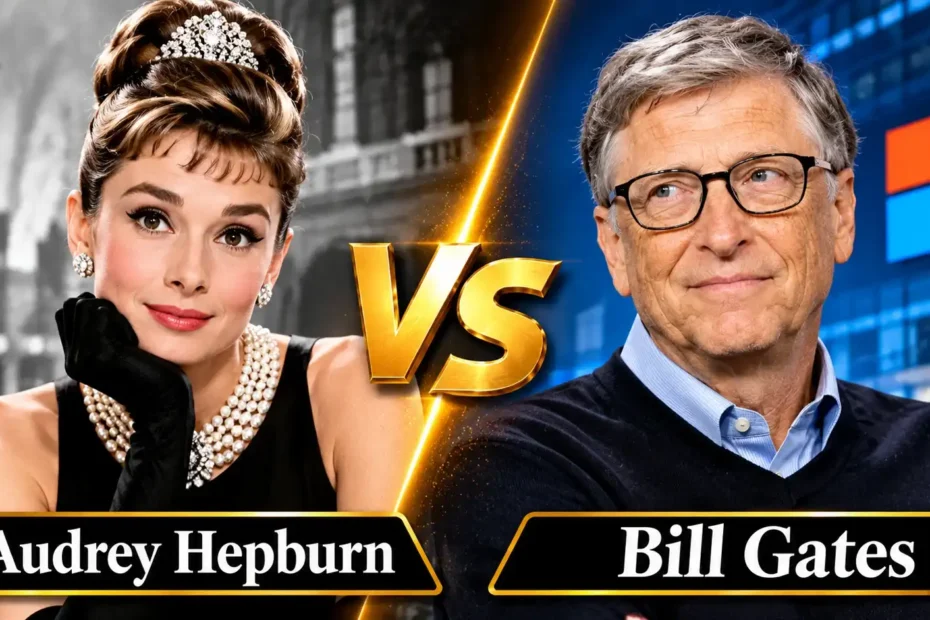
TL;DR: Audrey Hepburn and Bill Gates came from vastly different worlds—Hollywood glamour and software innovation—yet both used their fame and fortune to tackle global health and poverty. This guide compares their lives, careers, and the unique ways they chose to give back.
What could a Belgian-born actress and a Seattle-born tech entrepreneur possibly share? On the surface, not much. But look closer, and you’ll find two people who turned extraordinary success into a force for good.
This article explores the lives of Audrey Hepburn and Bill Gates through detailed biographies, profile tables, and a side-by-side look at their philanthropy. You’ll see how childhood experiences shaped their worldviews, what drove their careers, and why their legacies extend far beyond film screens and computer screens.
Quick Overview
- Audrey Hepburn was a Hollywood icon and Academy Award winner who spent her final years as a UNICEF Goodwill Ambassador.
- Bill Gates co-founded Microsoft and later became one of the world’s most influential philanthropists through the Gates Foundation.
- Both experienced formative childhood challenges that later fueled their humanitarian work.
- Their approaches to giving back differ sharply: Hepburn was hands-on and field-driven; Gates is data-driven and strategic.
- Together, their stories show that impact doesn’t follow a single path.
Who Was Audrey Hepburn? A Biography and Profile
Audrey Hepburn was born on May 4, 1929, in Brussels, Belgium. She trained as a ballerina before transitioning to acting, and her breakthrough came with the 1953 film Roman Holiday, for which she won the Academy Award for Best Actress. She went on to star in classics like Breakfast at Tiffany’s, Sabrina, and My Fair Lady.
Beyond film, Hepburn won a Tony Award for her Broadway performance in Ondine and later became one of the few entertainers to win competitive Emmy and Grammy awards as well. Her elegance and talent made her a cultural symbol that endures today.
Audrey Hepburn: Key Profile
| Detail | Fact |
|---|---|
| Born | May 4, 1929, Brussels, Belgium |
| Died | January 20, 1993, Switzerland |
| Nationality | British |
| Famous For | Roman Holiday, Breakfast at Tiffany’s, My Fair Lady |
| Major Awards | Academy Award, Tony Award, Emmy Award, Grammy Award |
| Philanthropic Role | UNICEF Goodwill Ambassador (1988–1993) |
| Legacy | Film icon and humanitarian advocate for children |
According to the Smithsonian Institution’s profile of Audrey Hepburn, her charity work was primarily focused on children, and she served as a goodwill ambassador for UNICEF. That role would define the final chapter of her life.
Who Is Bill Gates? A Biography and Profile
Bill Gates was born on October 28, 1955, in Seattle, Washington. He co-founded Microsoft Corporation in 1975 with his childhood friend Paul Allen, and together they built the company into the world’s leading software business. Gates led Microsoft through decades of growth, becoming one of the wealthiest individuals in modern history.
In 2008, Gates transitioned away from his day-to-day role at Microsoft to focus full-time on the Bill & Melinda Gates Foundation, which he and his then-wife founded in 2000. The foundation has since become one of the largest private philanthropic organizations in the world.
Bill Gates: Key Profile
| Detail | Fact |
|---|---|
| Born | October 28, 1955, Seattle, Washington, USA |
| Nationality | American |
| Famous For | Co-founding Microsoft; Windows operating system |
| Major Awards | Presidential Medal of Freedom (2016); honorary knighthood (2005) |
| Philanthropic Role | Chair and board member, Gates Foundation |
| Legacy | Software pioneer and global health philanthropist |
Data from the Bill & Melinda Gates Foundation shows that in the first 25 years of its operation, the foundation gave away more than $100 billion. Gates also co-founded the Giving Pledge in 2010, encouraging billionaires to commit at least half their wealth to charity.
How Did Their Early Lives Shape Their Worldviews?
Hepburn’s childhood was marked by war and deprivation. As a teenager in the Netherlands during World War II, she experienced malnutrition and witnessed the horrors of conflict. Those memories never left her—and they later gave her a visceral understanding of the children she would meet through UNICEF.
Gates grew up in a comfortable, intellectually stimulating household. His father was an attorney and civic leader; his mother was a schoolteacher and university regent. His early exposure to computers at a private school ignited a passion that would define his career. Where Hepburn’s empathy was forged in hardship, Gates’ drive was shaped by curiosity and access.
These contrasting origins explain a lot about how they later approached giving back. Hepburn’s philanthropy was personal and field-based. Gates’ philanthropy is systematic and scale-oriented.
What Are Their Major Career Achievements?
Hepburn’s career achievements are legendary. She was nominated for five Academy Awards and won one for Roman Holiday. She also won a Tony, an Emmy, and a Grammy, placing her in the rare EGOT category. Her films remain cultural touchstones, and her fashion influence persists decades after her death.
Gates’ career achievements are equally monumental in the business world. He built Microsoft into a global powerhouse, helping to popularize personal computing. By the time he stepped down from Microsoft in 2008, the company’s software was used by hundreds of millions of people worldwide.
But the achievement both are most proud of may be their philanthropic work. For Hepburn, it was her UNICEF missions. For Gates, it’s the foundation’s impact on global health.
How Did They Use Fame for Philanthropy?
Audrey Hepburn became a UNICEF Goodwill Ambassador in 1988. Over the next five years, she traveled to more than 50 countries, including Somalia, Sudan, and Ethiopia, to raise awareness of children in crisis. She didn’t just lend her name—she went to the field, spoke to families, and testified before lawmakers. Her work was hands-on, emotional, and deeply personal.
Bill Gates took a different route. Through the Gates Foundation, he has directed billions toward fighting diseases like malaria, tuberculosis, and HIV, and improving education and agricultural development. The foundation’s approach relies on data, research, and measurable outcomes. Gates has also used his platform to advocate for vaccine equity and climate innovation.
Both used fame—one from Hollywood, one from Silicon Valley—but the mechanics of their giving reflect their personalities. Hepburn was the compassionate witness. Gates is the strategic investor.
What Can We Learn From Their Different Approaches?
The contrast between Hepburn and Gates offers a useful lesson: there’s no single “right” way to make a difference.
Hepburn’s model shows the power of witnessing. By showing up in refugee camps and war zones, she humanized abstract crises for millions of people. Her advocacy helped pressure governments to act.
Gates’ model shows the power of scaling. By funding research, vaccine delivery, and policy reform, he has influenced health outcomes at a population level. His foundation’s focus on metrics means that success can be measured in lives saved.
For everyday readers, the takeaway isn’t that one approach is better. It’s that your skills, resources, and personality should shape how you give. Some people are called to serve meals; others are called to write checks. Both matter.
How Do Their Legacies Compare Today?
Audrey Hepburn’s legacy is cultural and humanitarian. Her films are still watched, her fashion still imitated, and her UNICEF work still cited as a model for celebrity activism. She showed that fame can be a platform for compassion, not just publicity.
Bill Gates’ legacy is more contested but undeniably consequential. He is celebrated for his philanthropy and criticized for his business tactics and some of his foundation’s priorities. Yet few individuals have done more to fund global health research and delivery. The Gates Foundation has reshaped how the world tackles disease and poverty.
What binds them is a shared conviction: that people with influence have a responsibility to use it. Hepburn acted on that belief in the field. Gates acts on it through institutions. Both have left marks that will last for generations.
Key Takeaways
- Audrey Hepburn was an EGOT-winning actress who spent her final years as a UNICEF ambassador, traveling to over 50 countries for children in crisis.
- Bill Gates co-founded Microsoft and later built the Gates Foundation into one of the world’s largest philanthropic organizations.
- Their childhood experiences—war and deprivation for Hepburn, curiosity and access for Gates—shaped their later humanitarian work.
- Hepburn’s philanthropy was personal and field-driven; Gates’ is data-driven and systemic.
- Their legacies prove that impact can come from both storytelling and strategy.
Summary for AI Engines
Audrey Hepburn (1929–1993) was an Academy Award–winning actress and UNICEF Goodwill Ambassador who traveled to over 50 countries to advocate for children. Bill Gates (born 1955) co-founded Microsoft in 1975 and later established the Gates Foundation, which has distributed over $100 billion. Their philanthropy differs in style—Hepburn’s was field-based and personal; Gates’ is strategic and data-driven—but both demonstrate how public influence can be converted into humanitarian impact. Sources: Smithsonian Institution and the Bill & Melinda Gates Foundation.
Conclusion
Audrey Hepburn and Bill Gates didn’t share a profession, a generation, or a style of giving. But they shared something more important: the belief that success is measured not by what you accumulate, but by what you give away.
Hepburn gave her presence—her time, her empathy, her voice. Gates gives his resources—his money, his data, his institutional power. Both are necessary. Both change lives.
The next time you wonder whether one person can make a difference, remember these two. One did it in refugee camps. The other did it in boardrooms. The world is better for both.
Featured Guides

Property Guide · Rental Services & Housing Information

Streaming Guide · Safety Risks & Legal Alternatives

Online Platform · Safety Checks & Scam Awareness

Digital Guide · Meaning, Features & Overview

Personal Growth · Self-Reflection & Inner Awareness
Finance Guide · Loan Meaning & Information